Taras Kuzio
Download PDF
Oct 27 2025
Image by Columbia University Press
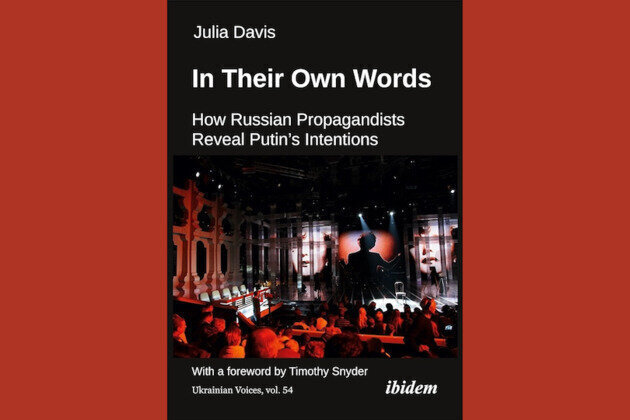
In Their Own Words: How Russian Propagandists Reveal Putins Intentions
By Julia Davis
Columbia University Press, 2024
Julia Davis book brings together 104 of her articles published in media outlets that analyse de-humanisation of Ukrainians on Russian television. The book has a foreword by Yale Universitys Timothy Snyder and a preface and afterword by Davis. This is the first book that brings together a detailed insight and analysis of how Russian television prepared the Russian public for the full-scale invasion through the de-humanisation of Ukrainians, and how Russian media has continued to mobilise public support for Russias war against Ukraine.
Peter Pomerantsevhas written of The challenge for anyone trying to bring propagandists to trial has always been connecting vile words to horrific acts. In June 2024, theFIDH (International Federation for Human Rights)submitted a Communication to the ICC (International Criminal Court) on hate speech in the Russian media that they believe had mobilised war crimes in Ukraine. Thus, it is surprising that of thesix indictmentsof Russians by theICC(International Criminal Court), none of them are for journalists.
FIDH had analysed over 2,000 video segments with statements made in the Russian media between 24 February 2022 and 24 February 2024. The Communication targeted former President and Deputy Chairman of the Russian Security Council Dmitri Medvedev, VladimirSolovyov, Russia-1 TV channel host; Editor of Russia Today Margarita Siimonyan; director of the state-owned media group Rossiya Segodnya Dmitry Kiselyov; popular radio and television presenter Sergei Mardan; andfirst deputy to the Chief of Staff of the presidential administration Alexei Gromov.
Independent media in Russia was closed down in 2021-2022, and has since only existed in exile. Simonyan, head of the Kremlin propaganda television channel RT (formerly Russia Today), called for the repression of the opposition in Russia by 1 May 2021 which, she believed, would prepare the ground for the special military operation against Ukraine (Davis, pp.82-83).
Russias constitution was changed in 2020 to allow Vladimir Putin to remain president until 2036, in effect making him president for life. Since 2020, Russia has transitioned from an authoritarian political system with a collective leadership to a dictatorship. Political repression has become widespread in Russia, andPutins dictatorship imprisons a higher number of political prisoners than in the post-Stalin Soviet Union. In avolumeedited by Ian Garner and myself, eleven scholars analyse how Russia has become a fascist dictatorship, based on an ideology of Russian imperial nationalism, where internal repression is intimately connected to external military aggression.
Davis analyses Russian state media which reflects the Kremlins official position. In these TV debates and news reports, Russia journalists, political technologists (consultants), academics, think tank experts and state officials have been given opportunities to lay out their disdain for Ukraine and Ukrainians and call for war crimes and genocide against Ukrainians who are resisting Russias liberation.
The Russian media has never hidden Russias goal of destroying the Ukrainian state and installing a Russian puppet state and replacing Ukrainians with Little Russians (one of three branches of a pan-Russian people, the others being great Russians and white Russians). Russias so-called special military operation was supposed to be a quick operation that would bring about regime change. The Russian media and Russian leaders have also never hidden its territorial revanchism and imperialism towards Ukraine. Russian TV routinely referred to Ukraine as the territory formerly known as Ukraine (Davis, p.188).
Davis (2024) study of Russian state media should be placed within context. The disintegration of the USSR in 1991 into fifteen republics was, as Putin explained, the demise of Historic Russia. Russians never viewed the Russian SFSR as their homeland, which was the entire Soviet Union. Unlike fourteen non-Russian Soviet republics, the Russian SFSR did not possess republican institutions such as a communist party, and therefore Russian and Soviet identities were de facto the same. Unlike Ukraine and even Belarus, the Russian SFSR did not declare independence from the USSR. This is why Alexander Motylwrotethat Russian nationalism is a myth as Russian nationalists had never sought to separate from the USSR or build an independent nation-state (Motyl, 1990, pp.161-173). Russian nationalists prefer empire over nation-state; indeed, Putin describes Russia as a state-civilisation without borders. One of the fundamental requisites for a nation-state is a territory surrounded by defined borders.
The Russian image of Russia was therefore always bigger than the Russian SFSR (Soviet Federated Socialist Republic) or Russian Federation. Depending on their political persuasion, Russians identify Russia as the Tsarist Empire, USSR, CIS (Commonwealth of Independent States), Eurasia, Russian World or Holy Rus (or a combination of them). As Richard Pipeswrotemore than half a century ago, unlike England and France, Russia never built a nation-state before it expanded into an empire, and therefore the two are always co-terminus in Russian identity.
Russian irridentism and imperialism towards Ukraine also has long roots. White Russian emigres, followers of the White anti-Bolshevik forces who were defeated in the Russian civil war, Russian nationalist dissident Alexander Solzhenitsyn, and other Russian nationalist forces always denied Ukraines right to Crimea and New Russia, the Tsarist term for southeastern Ukraine. They also could never accept a Ukrainian state fully independent of Russia; that is, the only option they would agree to is aLittle Russia closely aligned with and tied to Russia(Kuzio, 2022, pp.99-128); that is, a Ukrainian version of Alexander Lukashenkas Belarus.
The entire Russian political spectrum has laid territorial claim to Crimea throughout the post-Soviet era, ignoring Russias agreement to respect to respect Ukraines territorial integrity which was enshrined in the Budapest Memorandum (signed after Ukraine agree to give up the worlds third largest nuclear arms arsenal) and 1997 Russian-Ukrainian treaty. From 2008, and especially after Russias first invasion in 2014, Putin added to Crimea territorial claims towards Ukraines southeastern region. In April 2014, Putinrevived use of the term New Russia.
At the heart of Russian understanding of what constitutes Russia are three eastern Slavic countries Russia, Ukraine and Belarus who had constituted two thirds of the Soviet population and most of the USSRs political, military and security elites. Putins goal of rebuilding a new Eurasian union required the reconstitution of this eastern Slavic core that is described as the Russian World or, by the Russian Orthodox Church, as Holy Rus.
Since 1994, Lukashenka has rebuilt the Russian-Belarusian relationship of elder brother (Russians)-dependent (Belarusian) state that resembled their relationship in the USSR. In 2020, the Kremlins control was threatened by mass protests in Belarus against election fraud, which were brutally repressed with the assistance of Russia. Since then, Belarus has become a full Russian puppet state. In February 2022, Belarus was used as one of Russias invasion routes into Ukraine.
With Belarus firmly under Russian control, Ukraine was next in line. Russian attempts to Bosnianise Ukraine in 2014-2021 had failed; Ukrainian Presidents Petro Poroshenko and Volodymyr Zelenskyy had both rejected implementing the Russian understanding of the Minsk peace accords that would have created a federalised and weak Ukraine within Russias sphere of influence. Three months before it took place, Vladimir Zhirinovsky, former leader of the Liberal Democratic Party of Russia (in fact a pro-regime nationalist party), predicted on Russian TV the exact day (24 February 2022) and time (4am) of the Russian full-scale invasion (Davis, p.140).
In 2020-2021, the Russian media (especially TV) prepared the Russian public for the upcoming full-scale invasion that it claimed would be quickly victorious in defeating Ukraine and returning Ukrainians to their Little Russians roots. The US and NATO were blamed for the escalation not, of course, Russia (Davis, p.136).
Putinslong essay, published in July 2021, which should be understood as the Russian full-scale invasions manifesto, denied Ukraines right to exist as an independent state and declared Russians and Ukrainians to be one people. Putins invasion force of only 170,000 rested on Russian imperial nationalist myths that Ukraine was an artificial construct and US puppet state, Russian speakers were oppressed by Nazis who had come to power in 2014 in a putsch during the Euromaidan Revolution, and Little Russians would greet the Russian army as liberators. In comparison, in 1968, the Warsaw Pact troops that invaded Czechoslovakia, a country with a quarter of Ukraines population, using 250,000 troops.
Davis documents how numerous state officials, journalists, academics and experts confidently claimed on Russian TV that Ukraine would be defeated within 1-2 days some even claimed that it would only take a few hours. This view of a quick Russian military victory was alsopredominant in the West, and influenced the decision to initially only supply military aid useful for a guerrilla war. Western policymakers and think tank experts had under-estimated Ukraines resilience and had believed the myth of Russia possessing the second best army in the world. Ukrainians did not, however, welcome Russian troops as liberators, and instead their fight back has led to over one million Russian casualties and a global conflict. Russia is no longer optimistic of defeating Ukraine within hours or days.
Davis (p.2920) writes that state media has played a central part in prompting, encouraging, rationalizing and normalizing the Kremlins massacre of its next-door neighbours. Russian media propaganda since the mid-2000s has de-humanised Ukrainians and prepared the ground for what by mid-2025 totalled170,000 war crimescommitted by Russian military and security forces in Ukraine. This has included the mass murder, torture and raping of civilians (children, women, men), deportation of two million Ukrainians to Russia and kidnapping of 35,000 children. Russian media routinely calls for the destruction of the Ukrainian state and mocks the Ukrainian language, culture and traditions (Davis, p.292). The Ukrainian language was recognised by the Soviet regime; it is now decreed not to exist. Indeed, a huge 11-volume Dictionary of the Ukrainian Language was published in Soviet Ukraine from 1970-1980. Political scientist Sergei Mikheyev said the Ukrainian language does not exist and Ukraine needs to be destroyed (Davis, p.185). Denial of the Ukrainian language returned Russian nationalism to the views they had held in the Tsarist Empire which had banned use of Ukrainian in the nineteenth century.
Well known Russian TV host Vladimir Soloviov said, referring to Ukraine: When a doctor is de-worming a cat for the doctor, its a special operation, for the worms its a war, and for the cat its cleansing (Davis, p.292). Anton Krasovsky, director of broadcasting at RT, called for the drowning of Ukrainian children, burning of homes with Ukrainians inside, and grandmothers to be gang raped by Russian soldiers.
Simonyan, editor-in-chief of RT, said she had been waiting eight years since 2014 for the special military operation to happen, adding after it was launched: This is true happiness (Davis, p.291). Simonyan called Ukrainians ungrateful for the gifts they received from Russia in the USSR. They have become traitors towards us and, she points out, Russia knows what to do to traitors (Davis, p.137).
Simonyans regular appearances on Russian TV are always incendiary, Ukrainophobicand xenophobically anti-Western. The West are hypocrites, armed with Hitlers fascist rhetoric, plans and methods, she said (Davis, p.237). Simonyan said Russias war with the West began in Ukraine, a traditional Russian nationalist argument denying Ukraine agency by depicting it as an Anti-Russia puppet state of the US.
As Davis (p.294) writes, genocidal discourse is not solely confined to journalists and state officials. Academics and think tank experts are routinely invited to state TV, and they participate in similar genocidal discourse. Russan academics are happy to explain the logic of Kremlin-directed violence and to provide an intellectual gloss (Davis, p.294). Ukraine is a Russian land and Ukrainians are hoodwinked Russians (Davis, p.200). Henry Sardaryan, Dean at MGIMO (Moscow State Institute of International Relations), described Ukrainians as in fact Russians who refuse to admit this: These are absolutely Russian people, who speak the Russian language, but who are convinced that they represent anti-Russia and an anti-Russian element (Davis, p.184).
Russian imperial nationalistPavel Gubarevdescribed Ukrainians as Russians possessed by the devil. Russia would aim to convince them they are in fact Russians, but if this failed, they would be killed. Russia,Gubarevwarned, could kill one or five million Ukrainians: we can exterminate all of you. State Duma deputy Aleksey Zhuravliov called for the killing of five percent of Ukrainians, or two million, to solve the Ukrainian question (Davis, p.184).
Simonyan has called for Ukrainian troops resisting Russian forces, including prisoners of war, to be killed. Davis (p.201) has asserted there is no Russian-Ukrainian war, just a special military operation between anti-Russian, fascist, Russophobic Ukrainians who are seeking to murder other Ukrainians who consider themselves to be Russians.Surveysof the Ukrainian population since 2014 have found only 2-5 percent claiming to be ethnic Russians and 92-95 percent stating they are Ukrainians (Kuzio, 2022, p.235). As has often been the case with Russian imperial nationalists, they believe only they have a right to decide what constitutes reality inside Ukraine.
The special military operation goal of de-nazification means mass murder of Ukrainians. De-nazification is openly described in the Russian media in genocidal terms. Soloviov described the need for public hangings and executions and war crimes trials after Ukraine is liberated (Davis, p.161). Davis (p.188) writes that Russian TV often talks of the need to murder millions of Ukraine during the de-nazification process. Initially, Russian officials and journalists assumed de-nazification would be a quick process, but with Ukrainians putting up a stiff resistance to Russias full-scale invasion, this time frame has been extended to 15-20 years.
Russian state officials and journalists deny the special military operation is an invasion of Ukraine. Nobody is fighting against Ukraine, Simonyan said, were liberating Ukraine (Davis, p.144). Soloviov said the special military operation is not a war against Ukrainians but their de-nazification and de-militarisation that would remove NATOs fist that was directed at us (Davis, p.153).
Simonyan said Russia intervened in an existing civil war in Ukraine in support of one side, Russian speakers, who were allegedly being threatened with genocide. No international organisation or human rights body has found evidence of genocide.Less than two percentof Ukrainians believe Russias justification for launching its special military operation.
In Simonyans TV commentaries, she claims Russia is defending Russian speakers against Ukrainian Nazis. Although this has nothing to do with reality, this kind of argument is standard in official Russian discourse. When Russian Foreign Minister Sergei Lavrov was asked how it was possible for a Nazi state to be led by a Jewish president (i.e., Zelenskyy), heretortedthat Zionists had collaborated with the Nazis in the 1930s and Adolf Hitler had Jewish blood. Of course, these were both falsehoods.
As Davis explains, anybody who opposes Putin is automatically a Nazi and therefore the term when used by Rusia is devoid of its original meaning (Davis, p.153). In Russias eyes, Ukrainians, US President Joe Biden, EU leaders, US Congress men and women, and the German Chancellor are all Nazis who are attempting to preserve an allegedly Nazi regime in Ukraine (Davis, p.154). Everyone who opposes Russias special military operation is a Nazi (Davis, p.237).
Davis brings out the extreme anti-Western xenophobia fanned on state-controlled Russian TV. Simonyan described war with the US as inevitable (Davis, p.81). Konstantin Zatulin described the special military operation as a war against the West, a war against NATO (Davis, p.153). Soloviov said Russia was de facto at war with NATO because all of Ukraines military formations are carrying out NATOs tasks (Davis, p.152). The defeat of Ukraine will also be the defeat of the Western international order. Sidorov said, everything will start in Ukraine and then end up in defeat for the West and Russias return as a great power, equal in status to the US (Davis, p.85).
Anti-Western xenophobia has existed and grown in Putins Russia since the mid-2000s but there are two reasons why it is on steroids since 2022. The first is there is no other way to explain Ukraines resilience. If Ukrainians do not exist as a people separate to Russians, why are they fighting so hard against their so-called Russian liberators? To explain this conundrum, Russian imperial nationalists, such as Andrey Sidorov, deputy dean of Moscow State University, claim Russia is fighting against the collective West (Davis, p.85). The Kremlins belief in a quick military victory was based on the myth of Ukraine as an artificial construct and Little Russians greeting the Russian army.
The second reason is that Russia expected a similarly weak Western response as that of 2014 when Russia first invaded Ukraine, but they miscalculated. Since April 2022, the West has provided a large amount of military assistance to Ukraine, as well as financial assistance to build a Ukrainian defence sector. Today, 60 percent ofUkrainians weaponsarebuilt inside Ukraine. In 2022, after Russian forces withdrew from Kyiv, Kharkiv and Kherson, it turned to China, Iran, and North Korea for military support. These four countries are united by a loathing of what they call the US-led unipolar world and the hegemonic discourse of Western liberalism. Olga Skabeeva, another rabble rouser on Russian state TV, described the special military operation as transitioning into World War 3. Russias goal is not only the de-militarisation of Ukraine, but also to de-militarise NATO (Davis, p.187).
Davis has produced a formidable and unique analysis of how Russian state media has been, and continues to be, used to mobilise Russian support for a full-scale invasion through the de-humanisation of Ukrainians and its importance in maintaining public support for Putins war of aggression against Ukraine. The book is indispensable reading for those interested in locating the roots of genocidal discourse in Putins fascist dictatorship.
Further Reading on E-International Relations
- Review Memory Makers
- Review Russias Overlooked Invasion
- Review 20 Days in Mariupol
- Review The Frontline
- Review The Russo-Ukrainian War
- Review Rebel Militias in Eastern Ukraine
About The Author(s)
Taras Kuzio is a professor of political science at the National University of Kyiv Mohyla Academy. He is co-editor of Russia and Modern Fascism: New Perspectives on the Kremlins War Against Ukraine (Columbia University Press, 2025); co-author of The Four Roots of Russias War Against Ukraine (Cambridge University Press, 2025);Crimea: Where Russias War Started and Where Ukraine Will Win(Jamestown Foundation, 2024), and Russian Nationalism and the Russian-Ukrainian War (Routledge, 2022).
Editorial Credit(s)
Vaishnav Rajkumar
Tags
Armed ConflictGenocideRussiaUkraineWarXenophobia



 Share
Share
 Tweet
Tweet
 Share
Share
 Flip
Flip
 Email
Email